
How to Create a Space Gradient
What you will need:
Dye:- Dharma Trading bright aqua, purple pop, spearmint breeze, fluorescent lemon
- - ProChem Washfast Acid brilliant violet, black, turquoise , Aljo Lily Rose
- Citric Acid
- 4” or deeper stainless steel trays
- Induction double burner
- Steam heating element like a vegetable steamer or heater/proofer
- Reusable zip ties
- 60 ml luer lock syringe
- 1000 ml jug
- Gram scale
- Knomad Superwash Yarn of Choice (non superwash does not yield a crisp resist, nor does silk or alpaca, and thus, not as bright a “pop”)
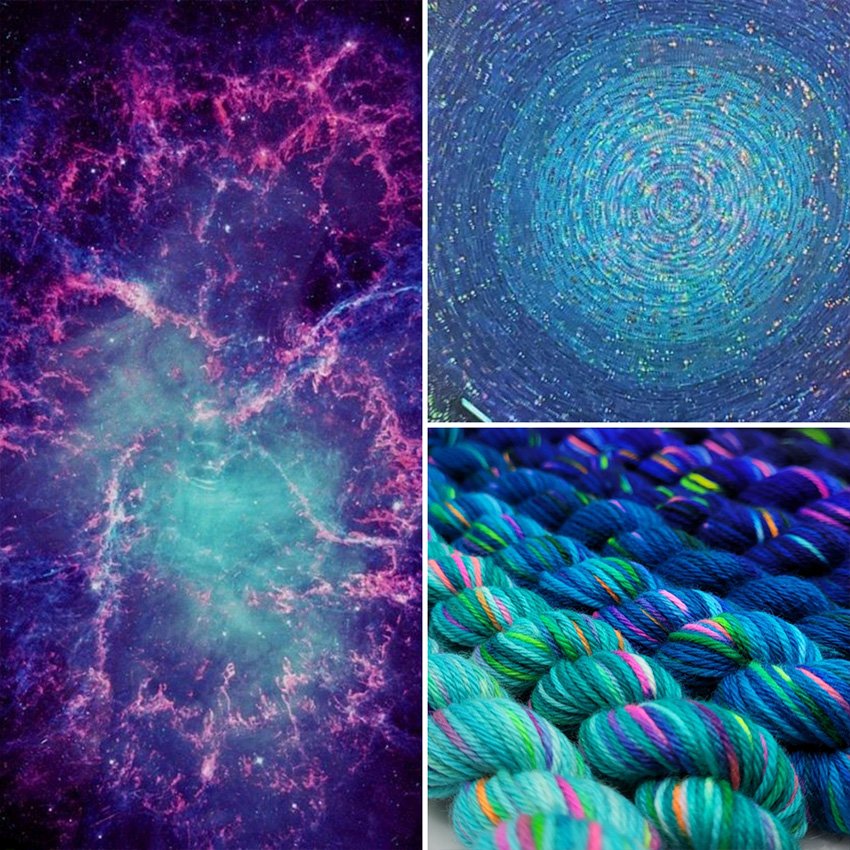
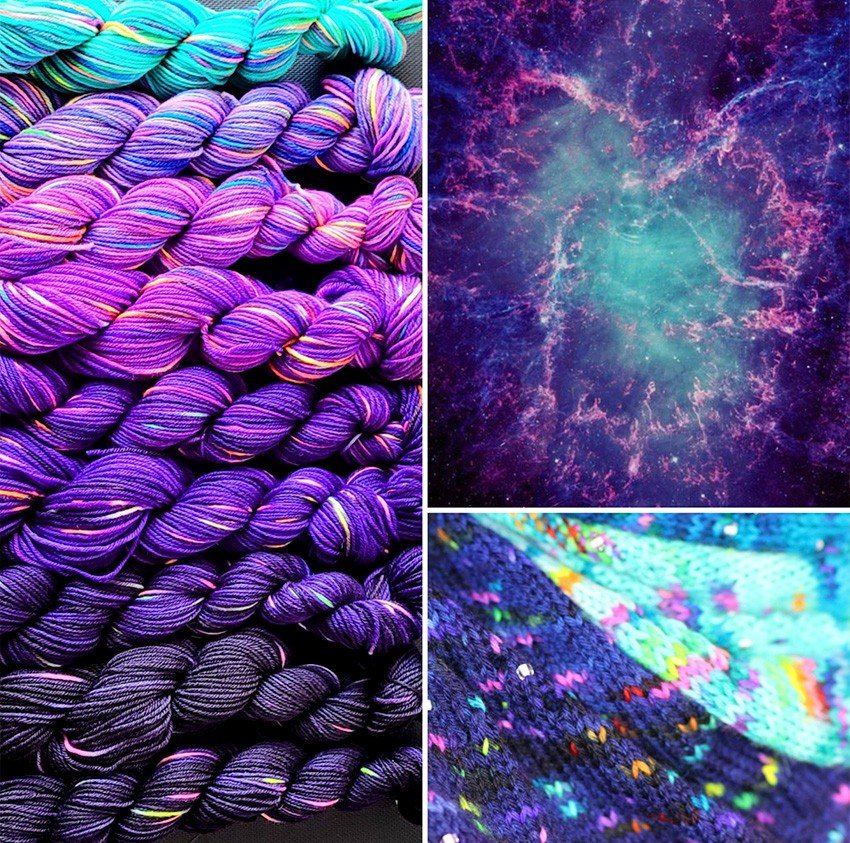 The color will be fading from an aqua blue to a super deep space blue/violet and the speckle concentration (to represent the stars in space) will be fading from 12 per repeat to 2, so the gradient is doing two different things simultaneously, the color moving in one direction and speckle density moving in the opposite direction.
As the color gets darker, the speckles fade to almost nothing, just like the edges of a nebula! Perfect time, with the new James Webb telescope images, to pick a nebula to recreate in yarn form and knit your way across the galaxy!
The color will be fading from an aqua blue to a super deep space blue/violet and the speckle concentration (to represent the stars in space) will be fading from 12 per repeat to 2, so the gradient is doing two different things simultaneously, the color moving in one direction and speckle density moving in the opposite direction.
As the color gets darker, the speckles fade to almost nothing, just like the edges of a nebula! Perfect time, with the new James Webb telescope images, to pick a nebula to recreate in yarn form and knit your way across the galaxy!
Step 1
Determine how many skeins you want, and how many resists each one is going to have. The “sweet spot” for resists is 6-8 in my opinion, you need a sufficient amount of “dark space” around each speckle or it gets too crowded and too many stars, not enough dark matter. This is 6 resists evenly spaced: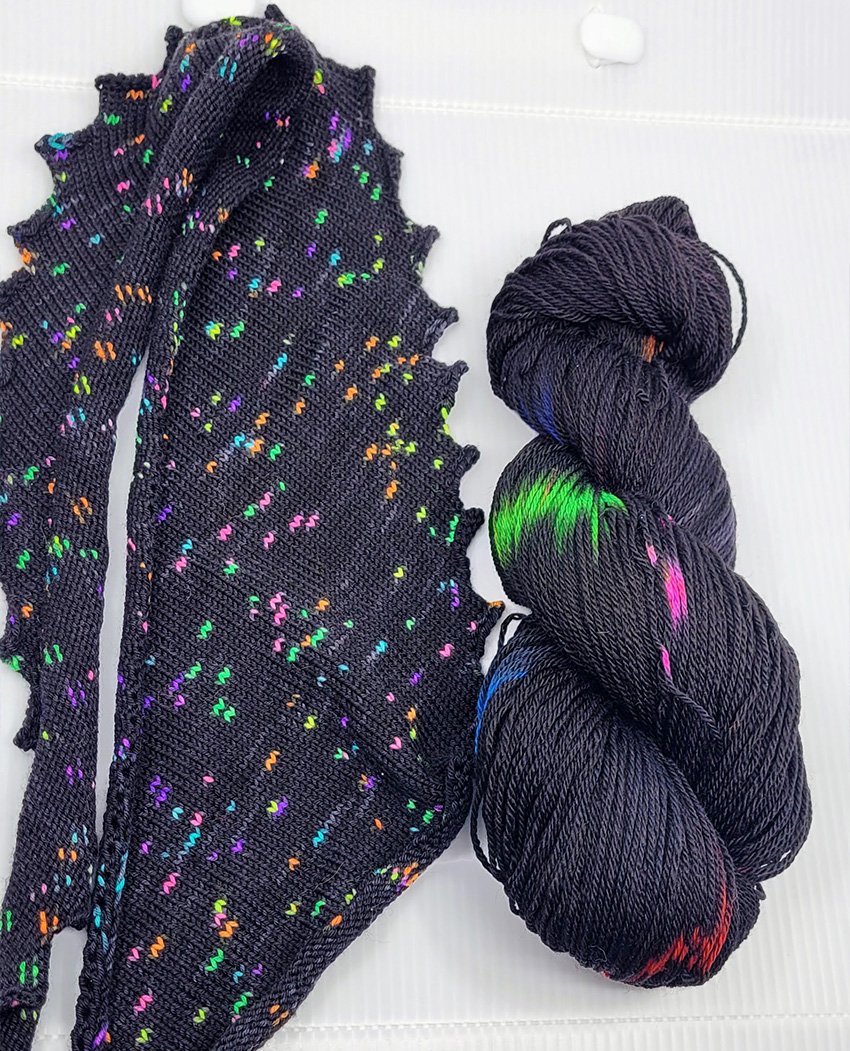 In our example for today’s nebula, we’re using 9 skeins.
- 12 resists (6 ties over both “legs” of the skein)
- 12 resists
- 10 resists
- 8 resists
- 6 resists
- 5 resists
- 4 resists
- 3 resists
- 2 resists

Step 2
I chose this blue to purple nebula because I loved how dramatic it was, but also easy to replicate with my favorite dye brands. Moreover, you can pick any nebula, but one that skews 1-2 colors will be easiest to create a gradient with, the rainbow nebulas require a lot more thought, planning and work. Here’s the formula for the background colors:- Skein 1: 1% bright aqua with a few drops purple pop ( gram of dye per 100 gram skein)
- Skein 2: .5% purple pop .5% bright aqua (.5 gram each)
- Skein 3: 1% purple pop (1 gram)
- Skein 4: 1.5% purple pop .5% brilliant violet (1.5 / .5)
- Skein 5: 1.5% purple pop 1.5% brilliant violet (1.5 each color)
- Skein 6: 2.5% brilliant violet .5% purple pop (2.5 / .5)
- Skein 7: 2.5% brilliant violet. 5% black (2.5 / .5)
- Skein 8: 2% brilliant violet 1% black (2 / 1)
- Skein 9: 2% black 1% brilliant violet (2 / 1)
Step 3
You need a hot, acidic dye bath and dry yarn for a crisp, clean resist like this. Let sit without boiling at 210 for 22 minutes, or until the dye is almost completely absorbed. Cool to room temperature.
Step 4
Remove all the resists and lay your yarn out. Remove all the resists.
Step 5
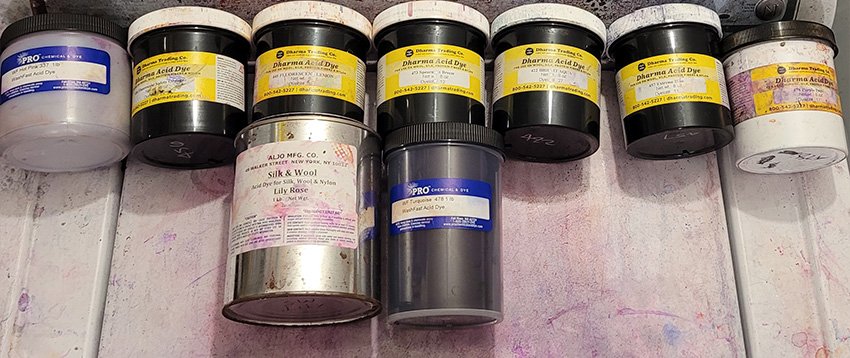
Mix the dye stock for the overdyeing of the white spots. The colors I picked are Aljo Lily Rose, Pro Chem Hot Pink and Turquoise, Dharma Flourescent orange, bright aqua, purple pop.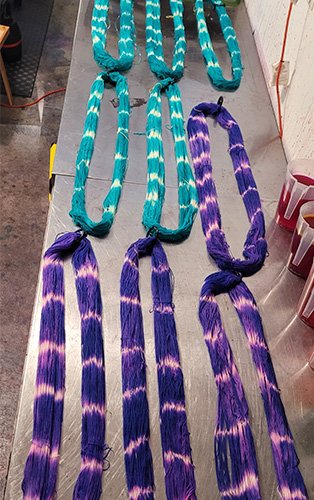
Step 6
Time to overdye the resists! I mixed 2.5 grams of dye powder per 1000 ml water. I like to use the absolute minimum of dye and massage it in so I don’t get too much “dye spread.” I don’t want the pops of color to be more than 1 or 1.5 stitches. Less is more. I chose to put the colors in rainbow order, you could choose to do all 1 color, or different saturations of 1 color, or random rainbows, or rainbows in order. Lots of options! If in doubt, make some mini skeins with different resist color orders and make swatches to find your favorite combination.
As you can see, I chose a happy neon rainbow, and as the colors got darker, I cut off the blue/purple speckles and concentrated on just pink/orange/yelllow as those colors pop the brightest in the finished piece.
I like to use the absolute minimum of dye and massage it in so I don’t get too much “dye spread.” I don’t want the pops of color to be more than 1 or 1.5 stitches. Less is more. I chose to put the colors in rainbow order, you could choose to do all 1 color, or different saturations of 1 color, or random rainbows, or rainbows in order. Lots of options! If in doubt, make some mini skeins with different resist color orders and make swatches to find your favorite combination.
As you can see, I chose a happy neon rainbow, and as the colors got darker, I cut off the blue/purple speckles and concentrated on just pink/orange/yelllow as those colors pop the brightest in the finished piece.
Step 7
Then, heat set your skeins. You can wrap in plastic wrap and pop in a steamer or a heater/proofer. I do not ever recommend the microwave, as you get hot spots and the dye color unevenly sets as well as the overheated spots being weaker in the finished project. Finally, let's leave the microwave for food, not heirloom quality garments out of fine Peruvian wool!Step 8
Knit your way through the galaxy on a luscious wool base from Knomad Yarn!